
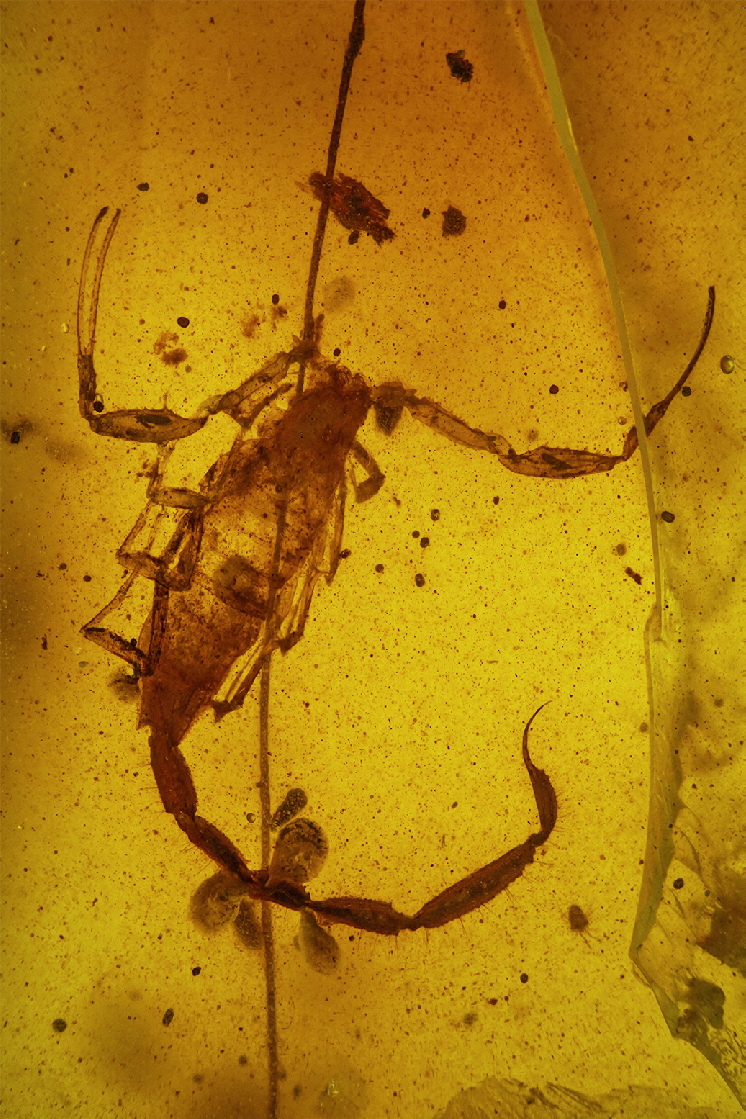
 Living fossils are really cool. They are basically extant (living) species that have remained morphologically the same as their ancient fossil ancestors. In the evolutionary view this morphological stasis over a long geological time span is hard to believe. Could it be that a squirrel-like creature became a human in the last 70 million years, but a living fossil like the coelacanth fish has remained virtually unchanged over that same time period? Charles Darwin is credited with the first mention of the term “living fossil” in his book Origin of Species: “These anomalous forms may almost be called living fossils; they have endured to the present day.” Other examples include Horseshoe Crabs, the Ginkgo Biloba tree, and the lizard-like Tuatara. A particularly interesting “living fossil” is the scorpion. Scorpions belong to the class Arachnida…as do spiders. Above is a picture of a Betaburmesebuthus bellus scorpion beautifully preserved in Burmese amber from the Lower Cretaceous period. It would therefore be considered over 100 million years old by palaeontologists within the old earth paradigm. But it looks just like a modern scorpion, probably walked like a scorpion, and probably stung like a scorpion! An ancient scorpion, recognizably similar to scorpions crawling around today is no problem for the creation model. We believe a global Flood just a few thousand years ago made the fossils like this amber and we don’t expect one kind of animal to morph into another. (Special thanks to David Burke for helping with this article.)
Scorpions as Living Fossils

