Defending the Stegosaurus Engraving
(Published in Journal of Creation 2026 Volume 40 Issue 1)
A recent paper in Journal of Creation claims that the stegosaur interpretation of the iconic Ta Prohm carving faces “increasing challenges.”[i] Indeed, the article is entitled “Problems Mounting for the Ta Prohm ‘Stegosaur’ Carving.” But the only piece of new evidence that the paper presents is a badly eroded carving that displays an indistinct quadruped. Otherwise, it just reworks older material.
Areas of Agreement
Let me begin by briefly touching on some areas in which I agree with the Author, then I will discuss problems with his arguments against the stegosaur interpretation. Firstly, it is important for creationists to critique each other’s work. An echo chamber within creationism isn’t useful for building robust models and marshalling the best evidence for apologetics. It may be deemed more glamorous to do field research and present novel evidence for the creation model. But we should also appreciate those who do the valuable service of reassessing and even challenging existing creation arguments. In this vein, I applaud the reanalysis work Halley is doing.[ii] We might not completely agree in the final analysis, but this is valuable work. It would also be helpful if critics of dinosaurian iconography would work to establish a protocol for analysis. What would be deemed acceptable evidence?
Secondly, the paper makes some valid points about the possible second stegosaur I introduced in my 2017 paper.[iii] Perhaps I made a bit too much of a scene that seemed to me to contain elements similar to the stegosaur engraving. As I said in the original article, the scene has largely disintegrated. Others have expressed to me some of the same reservations about the stegosaur identification as this recent paper brought up.
Finally, we agree that the original stegosaur carving does not seem to be mythical or chimeric in nature. I saw a great many carvings in my weeks in Cambodia, including numerous engravings that were clearly mythical in nature, often depicting scenes from traditional Hindu or Buddhist religious stories. This carving doesn’t seem to fit that mold.
Discussion about the Plates/Leaves
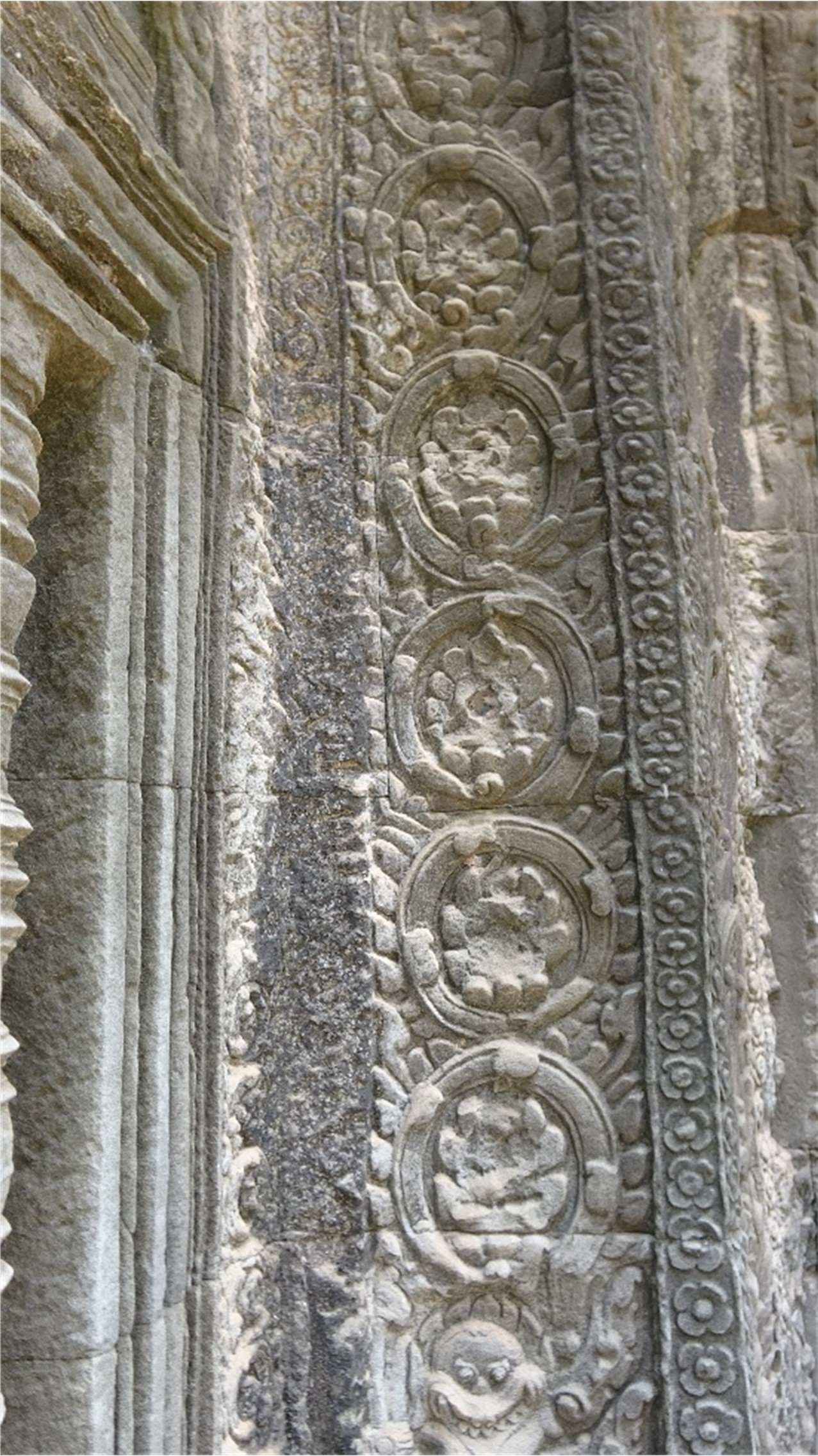 Now let’s discuss the paper’s actual arguments against the stegosaur interpretation. It rehashes the old contention that the apparent stegosaur plates are background vegetation, filling out the scene in the circle (roundel). But the idea that these plates are just pedals “cupping” the creature makes no sense. Proper “cupping” would go completely around the carving, as in the defaced Buddhist roundels near the stegosaur and on other columns. [Figure 1] Instead, the plates are just on top and follow the contour of the animal’s back, from the neck to the tail. They are not coming from some central plant stalk in behind the animal. Notice that the “petal” by the tail does not continue behind the animal, between the upper tail and the back leg.
Creationist Jim Brenneman visited Ta Prohm in 2020 and spent hours photographing and videotaping the stegosaur carving from every angle and even at different times of the day (which optimized lighting). All of these images were then uploaded into a 3-d modeling system by virtual reality technician Shawn Hoffman. This resulted in an extraordinary online model that allows the carving to be experienced from any angle in high resolution and good illumination. One can easily judge the relief depth at: https://sketchfab.com/3d-models/ta-prohm-stegosaurus-carving-fe3299afa22f47b497b6491ca29e44d2?fbclid=IwAR0JbfhauN8gXrsEobd0k3VAAampFBhB6YfQpnVVeBDH9XrosiyGpPKYLMQ
The recent paper by Halley points to large flowers carved on a column. It emphasizes the high relief of the plant’s distal edges, the pedals coming up towards the observer. But those flowers are artistic subjects. So, these examples only serve to buttress my point. When these protruding elements are part of the subject (flower pedals or stegosaur plates), they stand out in high relief. When they are decorative background foliage, they do not.
Relief Measurements
Halley is dismissive of the relief measurements that I took around the Ta Prohm site:
“If we are to have confidence that the ‘stegosaur plates’ are unique in relief depth, the handful of measurements taken by Woetzel are insufficient to demonstrate this.”[iv] Here he assumes (on no evidence whatsoever) that I only made a handful of measurements. Where does he get that idea from? Perhaps he infers it directly from evolutionist Scott Burnett’s paper in Skeptical Inquirer. Burnett wrote, “[A] recent attempt to dismiss this possibility and discern the intent of the carver through limited measurements (Woetzel 2017) is unconvincing.”[v] I actually made dozens of measurements all around Ta Prohm before concluding, “Depth analysis of multiple carvings around this temple consistently revealed relief of approximately 1 mm above the background for decorative flourishes.”[vi]
Ironically, I actually measured the very carvings that the Halley paper points to in Figure 6. The leaves there are not, in fact, comparable to the relief depth of the stegosaur plates. Indeed, I was unable to find any leafy background inside an animal roundel that extended over 2mm in relief. Halley has not visited the site and so he might be excused for getting this wrong. But Burnett spent plenty of time there. Why did he not confirm these measurements for himself? It isn’t a difficult task. I find it quite telling that he actually presents no evidence of his own but summarily dismisses my measurements.[vii]
The New Quadruped Roundel
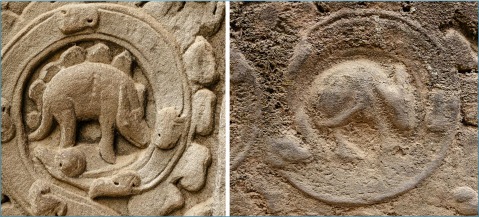 The Journal of Creation paper makes much of the vague, badly eroded quadrupedal animal carving that Burnett’s paper presented. [Figure 2 by Halley] But what is it? It could be a cow, rhino, pangolin or even a rat. It is hard to tell because the preservation isn’t good. What remains does not, in my opinion, look like the stegosaur engraving. The “head ornament” is completely different. In this vague quadruped carving the “ornament” follows the upper head contour on top and ends at about the eye on the bottom. It seems very much like a mammalian ear sticking out above the head. In contrast, the stegosaur carving has an odd, pointy “ornament” that follows the jawline at the bottom and ends below the eye on top. Other discrepancies include:
-
-
- The contour of the forehead is different.
- The head ends in a narrow rather than ‘boxy’ jaw.
- More slender body
- More slender legs
- The ‘feet’ are splayed out and less ‘hoof-like.’
- The body to head proportion is significantly different.
- The tails don’t match.
-
I hesitate to over-analyze this carving because it is so eroded that we are all just guessing at the actual animal depicted. But what the paper claims to be feet, I think more likely to be rocks or maybe ornamental knobs. Notice what appears to be a rock or knob just to the left of the oversized back ‘foot’. Also note the ornamental knob covering the stegosaur back foot. Finally, note how these ‘feet’ have higher relief than the leg itself (unlike the stegosaur foot). If these are not actually feet, this new quadruped looks quite like a rat or perhaps a large mouse.
Domesticated Stegosaurs?
The paper by Halley is also dismissive of my proposal that stegosaurs might have been domesticated. “But all of Woetzel’s speculations lack supporting evidence and are purely ad hoc.”[viii] However, the paper never actually engages the evidence I presented (the Chinese historical reports and their connection to the Khmer and the multiple elephant engravings lacking tusks). How are the Author’s explanations for the stegosaur tail not fitting his rhino identification and the horn being absent not “ad hoc”? Indeed, it seems the paper employs a double standard, one for the stegosaur interpretation and another for the rhinoceros interpretation. Even the evolutionist Burnett notes: “Some skeptics have claimed that the image represents another real animal with or without background vegetation (the dorsal plates), with rhinoceros, boar, pangolin, and lizard among the potential … I am leery of most of these identifications, primarily because each differs morphologically as much from the carving as does an actual stegosaur.”[ix]
Since I wrote my 2017 paper, I have come across additional accounts of the Chinese domesticating dragons and using them for transportation. Recently I read Biographies of Immortals. The book is a fascinating dive into Chinese history and legends. During the Chou Dynasty (1122-249 BC) a certain Ch’i Lung Ming allegedly discovered a juvenile green dragon near a pool of water. After raising the lizard-like reptile, he eventually rode upon its back.[x] Multiple stories feature dragons as draft animals. In one account the Yellow Emperor sent out his official courier Tu -Shih Chiin on an important mission in a chariot pulled by dragons.[xi] Large portions of the book are clearly fabulous, but other sections are more sober, likely accounts that were based on real life. The dragon stories might also be founded in actual historical experiences that became embellished over time.
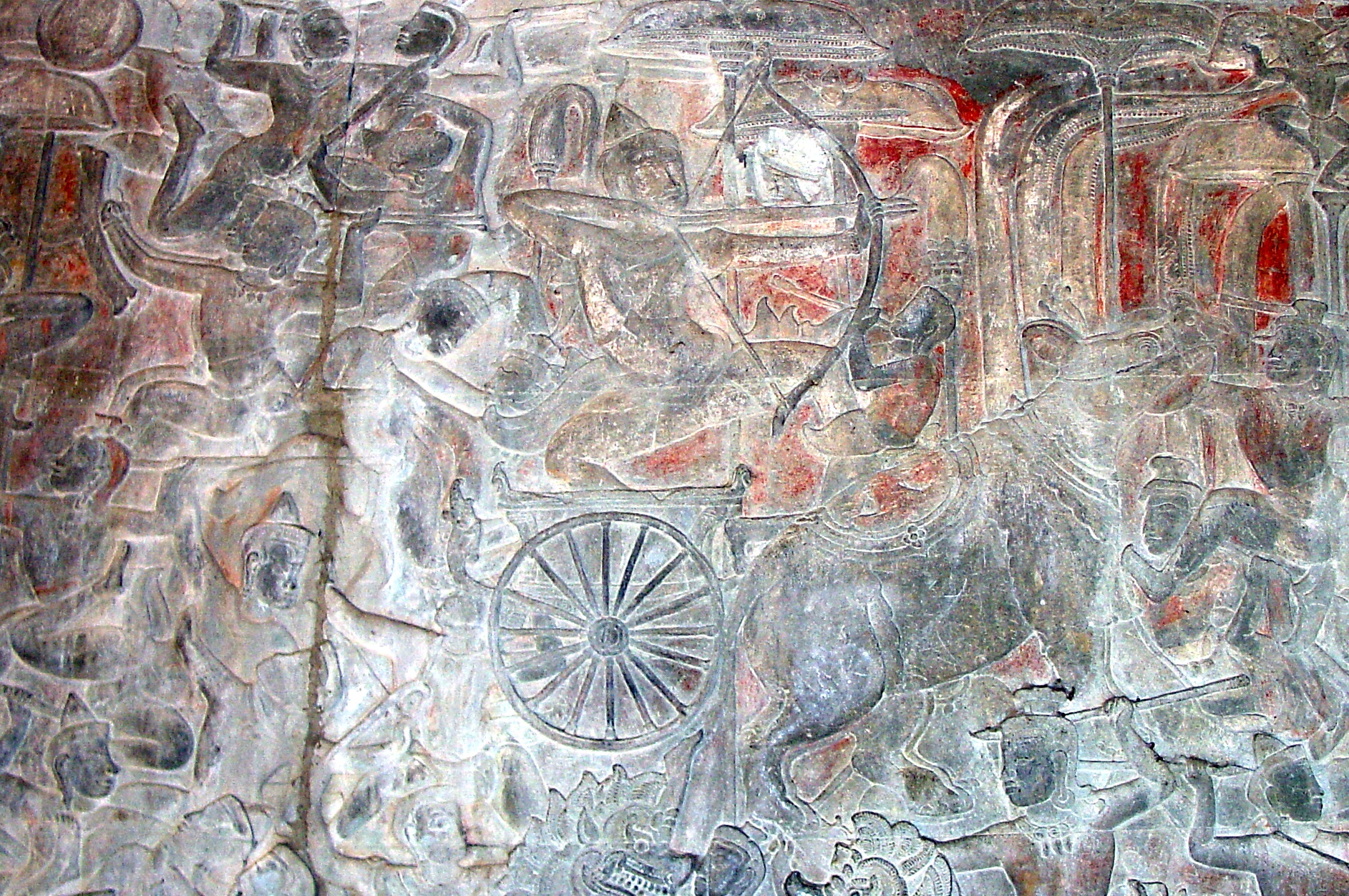 In the west wing of the north chamber of the main Angkor Wat Temple is a relief of the Hindu god Agni riding a chariot that is pulled by a rhinoceros. [Figure 3 after Wikimedia] If the Khmer heard of dragons pulling carts in China, it is certainly plausible that they would depict such a dragon at Ta Prohm. For creationists, I believe that still is the most reasonable explanation for the apparent stegosaur carving.
Acknowledgments
I would like to express my appreciation to Brian Thomas and Tim Clarey for reviewing an early draft of this Letter.
[i] Halley, Keaton, “Problems Mounting for the Ta Prohm ‘Stegosaur‘ Carving,” Journal of Creation, Volume 39:2, 2025, pp. 119-126.
[ii] Halley, Keaton, “Dinosaurs on Ancient Artifacts?: A reappraisal of Twelve Examples,” https://creation.com/dinosaur-artifacts, May 8, 2025.
[iii] Woetzel, D., “The Stegosaur Engravings at Ta Prohm,” Answers Research Journal 10, 2017, pp. 213–220.
[iv] Halley, p. 121.
[v] Burnett, Scott E., “A Stegosaur Carving on the Ruins of Ta Prohm? Think Again,” Skeptical Inquirer Volume 43:4, July/August, 2019, p. 46.
[vi] Woetzel, p. 215.
[vii] This is not the only such error in Burnett’s paper. He writes, “[T]he typical tail spikes were removed by their keepers to make them less dangerous (Woetzel 2017). In other words, some contend that the ancient Khmer not only lived alongside dinosaurs but had also domesticated them!” This is incorrect. I suggested that the Chinese, not the Khmer, domesticated them. He later proceeds to make much of the fact that the Khmer have no historical reports of domesticating dragons.
[viii] Halley, p. 119.
[ix] Burnett, p. 49.
[x] Giles, Lionel, et al., Biographies of Immortals: Legends of China, 2010, p. 272.
[xi] Giles, p. 105.