
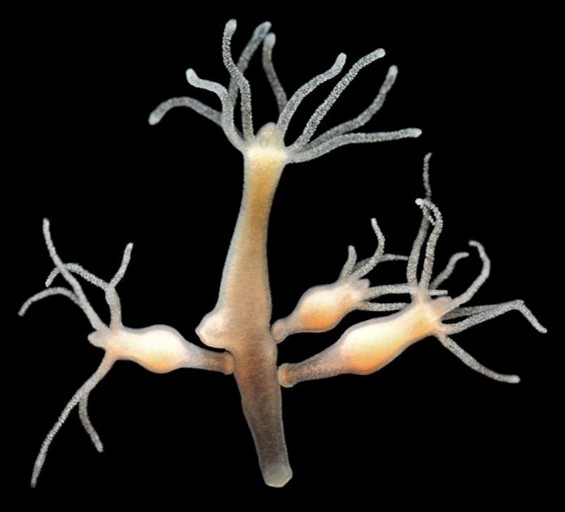
 Recently my friend John Beaton drew my attention to the tiny biological wonder that is the hydra. This aquatic “mini monster” defies all of our normal notions of biological aging and death. The animal’s name comes from ancient Greek mythology of a multi-headed water serpent. In the legend, the beast grew two replacement heads for every one that was severed. The hydra in the picture is related to the marine jellyfish, but it lives in fresh water. It’s body is very simple…no brain, heart, or eyes. In fact, it’s basically just a tube with tentacles and a hungry mouth attached at the top! To get around not having eyes, hydra have a unique way to sense the world. In 2010, genomic researchers discovered it contains the genetic material needed to build photosensitive proteins (found in animal’s eyes). But in the case of hydra, these proteins are found on the creature’s tentacles and mouth. They sense sudden shadows and other quick light changes. Thus it detects and strikes any small prey that wanders into its field of “non-vision”. The hydra kill their prey using tiny, harpoon-like stinging cells. Then the unfortunate victim goes down the center hatch. Hydra use the nutrients to build new hydra that “bud” off of its body. Note how the hydra in the picture has three mature offspring and one new bud forming. But what makes the hydra really special is that they can regenerate their body parts indefinitely. This tiny creature is only the size of a grain of rice, yet it completely replaces all of its body cells every 20 days. Unlike us, a hydra makes near-perfect copies of its stem cells without degrading over time. Thus it avoids senescence or aging…basically biological immortality. Cut a hydra into pieces and a section will grow into a complete new hydra. Might a similar immortal biological mechanism have been built into the pre-Curse bodies of Adam & Eve?
The Undying Hydra

